
Books
Books reflect years of prior research and contemplation. A book is usually published after a time lag once an intellectual project is completed, often well into the commencement of further new projects. That’s only natural.
A good book also reflects an author or a collaboration’s culmination of a period of dialogue and dissent. It can reflect a specific moment in time when a working framework for a particular discipline, theme, or research methodology is in use or contestation. As times change, those frameworks advance (as they should).
A good book takes on a timeless quality by probing long-standing or complex issues.

Cancer Care in Pandemic Times: Building Inclusive Local Health Security in Africa and India (2024, Palgrave McMillan International Political Economy Series)
Editors: Geoffrey Banda, Maureen Mackintosh, Mercy Karimi Njeru, Fortunata Songora Makene, Smita Srinivas
Read more about it here. The book is unique and emerges from a strong multidisciplinary team drawn from several countries.
“This open access edited volume focuses on the scope and benefits of strengthening local industrial-health linkages. The Covid-19 pandemic collapsed international supply chains for health. That experience brought home to African policy makers the critical nature of local manufacturing capabilities for sustaining and strengthening health care, and highlighted the pandemic benefits of India’s much stronger industrial base. At that time, a network of researchers in East Africa, India and the UK were investigating how to address the crisis of cancer care in low-resource health systems. Their project, uniquely, focused on the scope and benefits of strengthening local industrial-health linkages. The project researchers were also drawn into the pressing demands of Covid19 response.
The result is this very timely book. The authors link their research on cancer to pandemic experience, and they draw sharp lessons for how countries can enhance their populations’ health security. The authors argue that improving cancer care is crucial for human wellbeing and more inclusive health care. They challenge policy makers to bring together health needs, health innovations and improved industrial capabilities to embed better cancer care and broader health system improvement in local industrial innovation and development.”
“This is a book whose time has come. Covid-19 should have forced a fundamental shift in thinking around the way African healthcare systems are organised, and how and where they procure essential health commodities. I recommend this book for every African policy maker, parliamentarian, opposition politician, financier, and especially for the political champions and civil servants in the Ministries of Health, Finance, Trade and Industry, Science and Education across the African continent.”
–Dr Skhumbuzo Ngozwana, President & CEO Kiara Health; Board Chairman Biovac; Board Member, Federation of African Pharmaceutical Manufacturers Associations, South Africa
About the International Political Economy series of which this book is a part:
The global political economy is in flux as a series of cumulative crises impacts its organization and governance. The IPE series has tracked its development in both analysis and structure over the last three decades. It has always had a concentration on the global South. Now the South increasingly challenges the North as the centre of development, also reflected in a growing number of submissions and publications on indebted Eurozone economies in Southern Europe. An indispensable resource for scholars and researchers, the series examines a variety of capitalisms and connections by focusing on emerging economies, companies and sectors, debates and policies. It informs diverse policy communities as the established trans-Atlantic North declines and ‘the rest’, especially the BRICS, rise.
NOW INDEXED ON SCOPUS!

Market Menagerie: Health and Development in Late Industrial States
Smita Srinivas
Winner of the biennial 2015 Joan Robinson Prize (former Myrdal Prize) from the European Association for Evolutionary Political Economy (EAEPE) Read more about it here.
Awarded biennially for the best published monograph (i.e. book, excluding multi-authored collections of essays) on a theme broadly in accord with the EAEPE Theoretical Perspectives.
Well before Covid-19, India and other global supplier countries have struggled and advanced in their technological capabilities. They strongly influence access to healthcare wherever you are.
Market Menagerie examines technological advance and market regulation in the health industries of nations such as India, Brazil, South Africa, Nigeria, and China. Pharmaceutical and life science industries can reinforce economic development and industry growth, but not necessarily positive health outcomes. Yet well-crafted industrial and health policies can strengthen each other and reconcile economic and social goals.
This book advocates moving beyond traditional market failure to bring together three uncommonly paired themes: the growth of industrial capabilities, the politics of health access, and the geography of production and redistribution.
“Smita Srinivas uniquely synthesizes three different perspectives in relation to developmental states: the provision of health services, the emergence of industrial economies, and the role of the state. Her highly original analysis constitutes a significant contribution to our understanding of the political economy of development.”
—Susan S. Fainstein, Harvard University and author of The Just City
“It often is presumed that economic development more or less automatically brings with it better medical care and health to the population of a country. The case of India reveals just how untrue this is. In this fine book, Srinivas describes (in fascinating detail) why recent rapid economic development in India has not led to broad improvements in health, and provides a rich analysis of what is needed for improvement.”
—Richard R. Nelson, Professor Emeritus and Director of the Program on Science, Technology, and Global Development at the Columbia Earth Institute, Columbia University
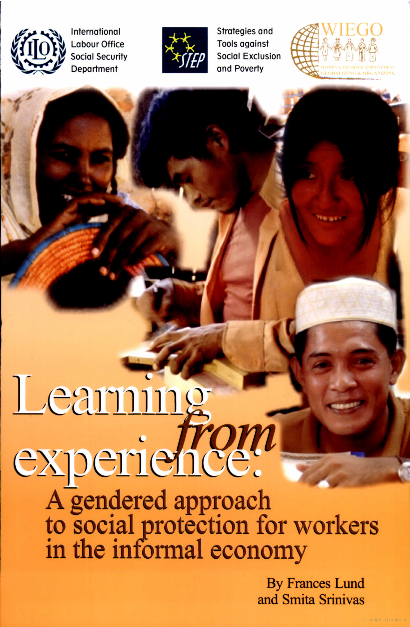
Learning from Experience: A Gendered Approach to Social Protection for Workers in the Informal Economy
Smita Srinivas (Co-authored with Frances Lund)
Read more about it here.
This commissioned book was presented to a global audience at a historic plenary in 1999 where workers in the informal economy were first officially represented at the ILO’s meeting. Smita Srinivas has been involved in two books published by the International Labour Organization (ILO): Learning from experience: A gendered approach to social protection for workers in the informal economy (Geneva: ILO, WIEGO 2000/2005 with Frances Lund), and Women Organizing for social protection, The Self-employed Women’s Association’s Integrated Insurance Scheme, India (Geneva: International Labour Office, STEP Programme, 2001).
Lund and Srinivas (2000 WIEGO/ILO), was subsequently reprinted in 2005, a best-seller, according to the ILO. It formed the core of WIEGO’s social protection program for many years.

Routledge Companion to Planning in the Global South
Smita Srinivas (Co-edited with Gautam Bhan and Vanessa Watson)
Read and get Preview Access here.
Economic development plans and policies are economic with institutional, physical, and spatial elements, including the critical aspect of industry growth and urbanisation patterns. “The Routledge Companion to Planning in the Global South offers an edited collection on planning in parts of the world which, more often than not, are unrecognized or unmarked in mainstream planning texts. In doing so, its intention is not to fill a ‘gap’ that leaves this ‘mainstream’ unquestioned but to re-theorize planning from a deep understanding of ‘place’ as well as a commitment to recognize the diverse modes of practice that come within it.” (from Abstract)

Srinivas, S. (2021) ‘Institutional Variety and Sustainable Industrial Policy’, Background paper BP13, prepared for the Industrial Development Report (IDR) 2022, Department of Policy, Research and Statistics Working Paper 20/2021, United Nations Industrial Development Organisation (UNIDO): Vienna.
This book was also published by OrientBlackSwan for the Indian subcontinent and priced accordingly.
“This collection reveals an incredible diversity in thought and practice in the urban planning field, across the rich range of sectors, planning issues, and geographies represented. Planning is always context dependent and this volume helps distill lessons across cases while appreciating differences. It highlights guidance for fast-growing cities in the global south that stems from their own experiences rather than discredited notions of universal “best practice.” It is imperative reading for everyone focusing on research and practice in the global south.”
– Aniruddha Dasgupta, Global Director, WRI Ross Center for Sustainable Cities, USA